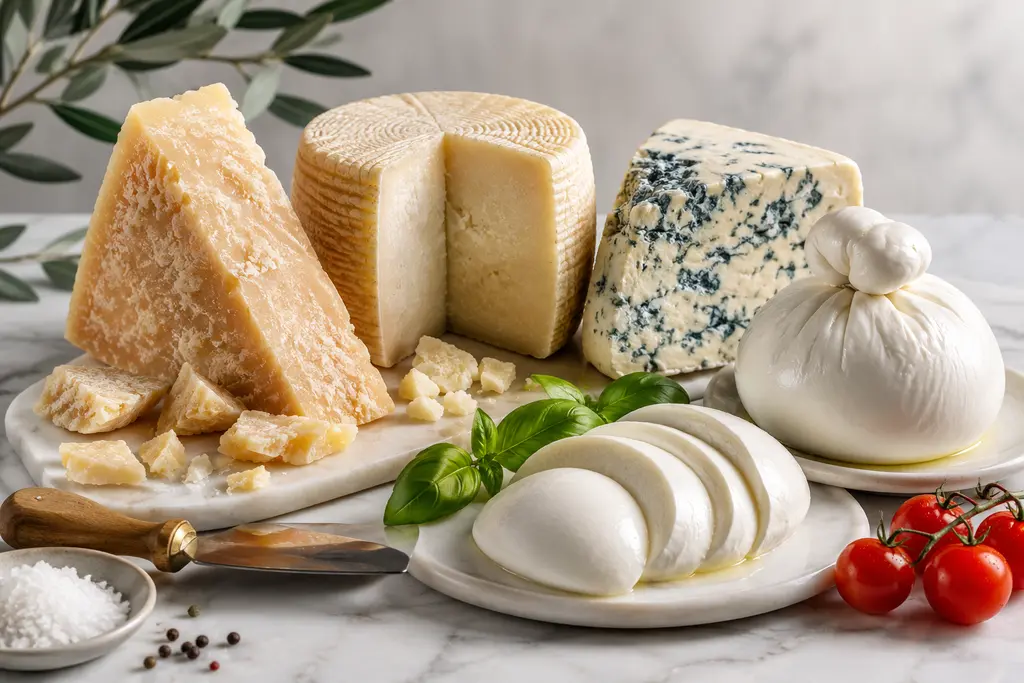
5 Italian Cheeses Everyone Should Know
Italian cheese is as diverse as the country's regional cuisine. From centuries-aged Parmigiano Reggiano to delicate Burrata, these five cheeses define the flavours, traditions, and craftsmanship of Italy.
The five cheeses at a glance
Italian cheese culture is a complex map of geography, history, and strict legal protections. To understand these cheeses is to understand the diverse landscapes of Italy, from the Alpine pastures of the north to the sun-drenched plains of the south. These five varieties—Parmigiano Reggiano, Pecorino Romano, Gorgonzola, Burrata, and Mozzarella—represent the pillars of Italian dairy tradition, each governed by “Denominazione di Origine Protetta” (DOP) status, which ensures they are produced using traditional methods in specific geographic zones.
While many international versions of these cheeses exist, the authentic Italian iterations are defined by their “terroir.” Factors such as the specific breed of cattle, the local microflora in the air during the ageing process, and the mineral content of the grazing land all contribute to the final flavour profile. Whether it is the sharp tang of a sheep’s milk cheese from the Roman countryside or the buttery decadence of a fresh Puglian cream-filled pouch, these cheeses offer more than just salt and fat; they offer a connection to centuries of agricultural heritage.
The following table provides a high-level overview of their characteristics before we explore each in depth.
| Cheese | Region | Milk | Texture | Flavour | Best uses |
|---|---|---|---|---|---|
| Parmigiano Reggiano | Emilia-Romagna | Cow | Hard, granular, crystalline | Nutty, umami, savory | Grating over pasta, cheese boards |
| Pecorino Romano | Lazio, Sardinia, Tuscany | Sheep | Hard, dense, crumbly | Sharp, salty, piquant | Carbonara, Cacio e Pepe |
| Gorgonzola | Lombardy, Piedmont | Cow | Creamy (Dolce) or Crumbly (Piccante) | Tangy, buttery, blue-veined | Risotto, sauces, with honey |
| Burrata | Puglia | Cow | Soft skin with a creamy interior | Buttery, milky, rich | Salads, served fresh with bread |
| Mozzarella | Campania, Puglia | Buffalo or Cow | Soft, elastic, moist | Mild, lactic, fresh | Pizza, Caprese salad |
Parmigiano Reggiano
Often called the “King of Cheeses,” Parmigiano Reggiano is a masterpiece of slow maturation and strict artisanal standards. Its history dates back nearly nine centuries to the Middle Ages, when Benedictine and Cistercian monks in the Po Valley sought a way to preserve the large quantities of milk produced by their herds. By the 12th century, the cheese had already taken the form we recognize today—a massive, long-ageing wheel capable of being transported across Europe without spoiling.
The production of Parmigiano Reggiano is restricted to the provinces of Parma, Reggio Emilia, Modena, and parts of Mantua and Bologna. It is made from raw cow’s milk, specifically from cows fed a diet strictly of local hay and grass; the use of fermented silage is strictly forbidden. This diet ensures the milk contains the specific natural bacteria required for the cheese to age successfully for several years. The process involves mixing whole milk from the morning milking with naturally skimmed milk from the previous evening. This mixture is heated in copper vats, coagulated with calf rennet, and the resulting curds are broken into tiny granules before being cooked.
The flavour profile of Parmigiano Reggiano evolves significantly with time. At 12 months, it is delicate with notes of milk and fresh fruit. By 24 months, it develops the characteristic “tyrosine” crystals—small, crunchy protein clusters that indicate proper maturation—and tastes of melted butter and nuts. Beyond 36 months, the cheese becomes intensely savory and umami-rich, with notes of dried fruit and spice.
What makes Parmigiano Reggiano unique is its complete lack of additives or preservatives. The only ingredients are milk, salt, and rennet. Its texture is “granitica” (granular), meaning it breaks into shards rather than being sliced. Traditionally, it is used as a finishing touch for pasta, but in Italy, it is equally valued as a table cheese, often served with a few drops of traditional balsamic vinegar from Modena or paired with robust red wines like Lambrusco or Sangiovese.
Pecorino Romano
Pecorino Romano is one of Italy’s oldest and most historically significant cheeses. Its roots reach back to the Roman Empire, where it served as a primary ration for legionaries due to its high nutritional value and exceptional shelf life. Virgil, in his Georgics, noted the importance of this sheep’s milk cheese in the daily Roman diet. While the name suggests a Roman origin—and it is still produced in the Lazio region—the vast majority of production shifted to the island of Sardinia in the late 19th century to accommodate the high demand for sheep’s milk that the Roman countryside could no longer provide.
Unlike Parmigiano, which uses cow’s milk, Pecorino Romano is made exclusively from whole sheep’s milk (pecora meaning sheep). The production involves a process called “dry salting,” where salt is repeatedly applied to the exterior of the wheel over several months. This results in a much higher sodium content compared to other Italian hard cheeses, giving Pecorino its signature sharp, salty, and slightly “stinging” piquant finish.
The texture of Pecorino Romano is dense and crumbly, though it lacks the specific granular crunch of Parmigiano. It is aged for a minimum of five months for use as a table cheese and at least eight months for use as a grating cheese. The aroma is pungent and unmistakably lactic, with a characteristic “sheepy” funk that provides a necessary counterpoint to rich fats and black pepper.
Pecorino Romano is the backbone of Roman cuisine. It is the essential ingredient in the “Four Roman Pastas”: Gricia, Carbonara, Cacio e Pepe, and Amatriciana. Because it is so salty, it is rarely used as a standalone snack in large quantities, but rather as a seasoning agent. Its unique ability to emulsify with hot pasta water to create a creamy, stable sauce is what makes it irreplaceable in the kitchen. It is often paired with broad beans (fave) in the spring—a traditional Roman snack that balances the salt of the cheese with the sweetness of the fresh beans.
Gorgonzola
Gorgonzola is Italy’s premier blue cheese, a pungent, marbled delight originating from the Lombardy and Piedmont regions. While its exact origins are debated—some historians place its birth in the town of Gorgonzola in 879 AD, while others suggest the Valsassina valley—the cheese was born from the “transhumance” tradition, where cows were moved from Alpine pastures to the plains. This journey left the cows tired (stracche), and the milk they produced was used to make Stracchino di Gorgonzola.
The cheese is made from whole cow’s milk and inoculated with spores of Penicillium roqueforti. During the ageing process, cheesemakers pierce the wheels with metal rods to allow oxygen to enter, which triggers the growth of the characteristic blue and green mold veins. This process, known as “erborinatura,” gives the cheese its parsley-like appearance.
Gorgonzola is produced in two distinct styles: Dolce and Piccante. Gorgonzola Dolce is aged for a shorter period (around 50 to 80 days). It is incredibly soft, creamy, and spreadable, with a mild, buttery flavour and subtle hints of sweetness. Gorgonzola Piccante is aged longer (80 to 150 days), resulting in a firmer, more crumbly texture and a much sharper, spicy, and more pungent bite.
The uniqueness of Gorgonzola lies in this duality. The Dolce version is frequently used in creamy pasta sauces or swirled into polenta, while the Piccante version is a staple of sophisticated cheese boards. Its affinity for sweetness makes it an excellent partner for honey, pears, walnuts, and dessert wines like Picolit or Vin Santo. Despite its strong aroma, a high-quality Gorgonzola should always taste clean and lactic, never bitter or overly “soapy,” which can be a sign of poor maturation.
Burrata
Burrata is a relative newcomer in the world of Italian cheese, having been created in the early 20th century in the city of Andria in Puglia. It was originally a clever solution by cheesemaker Lorenzo Bianchino to minimize waste. He took the leftover scraps (ritagli) of mozzarella curds, mixed them with fresh cream, and encased them in a “bag” of stretched mozzarella dough. What started as a local farm-style delicacy has since become a global sensation.
The name “Burrata” comes from the Italian word burro, meaning butter, which describes the rich, decadent interior of the cheese. Production is still centered in Puglia, where it is made by hand. The outer shell is a pouch of pasta filata (stretched curd), similar to mozzarella, which is blown or shaped into a balloon. This is filled with stracciatella—a mixture of shredded curds and heavy cream—and then tied off at the top.
The flavour of Burrata is the essence of fresh milk and sweet cream. Because it is so high in fat and moisture, it has an incredibly short shelf life and should ideally be eaten within 24 to 48 hours of being made. When sliced open, the creamy center should spill out onto the plate, creating a contrast between the slightly elastic skin and the luxurious, liquid interior.
Burrata is unique because it is a cheese of textures. It should never be cooked, as heat would destroy the delicate balance of the cream interior; instead, it is served at room temperature to allow the fats to soften. It is most traditionally served with high-quality extra virgin olive oil, crusty bread, and perhaps a few ripe tomatoes or a slice of prosciutto. Its richness makes it a perfect foil for acidic ingredients like balsamic vinegar or citrus.
Mozzarella
Mozzarella is perhaps the most famous Italian cheese worldwide, yet the version most people consume is far removed from the authentic Italian original. Historically, Mozzarella was born in the marshlands of Campania, where water buffalo were used for tilling the land. The milk of these buffalo, being much higher in fat and protein than cow’s milk, produced a cheese of exceptional richness. Today, the “Mozzarella di Bufala Campana” is protected by DOP status, while the cow’s milk version is known as “Fior di Latte.”
The defining characteristic of Mozzarella is the pasta filata (stretched curd) method. After the curds are formed, they are immersed in hot water and kneaded until they become elastic and shiny. The cheesemaker then “cuts” the dough into individual balls—a process called mozzare, which gives the cheese its name. These balls are then stored in a brine or whey liquid to maintain their moisture.
The flavour of authentic Buffalo Mozzarella is complex: it is milky, slightly tangy, and has a distinct musky note from the buffalo milk. Its texture is soft but resilient; when you bite into a fresh ball, it should “weep” a small amount of white, milky liquid. Fior di Latte, made from cow’s milk, is milder and has a cleaner, more delicate lactic sweetness, making it the preferred choice for Neapolitan pizza because it melts more predictably without releasing excessive moisture.
Mozzarella is unique because of its high water content and elasticity. Unlike hard cheeses, it is not aged at all and is intended to be eaten “fresh from the vat.” In Italy, it is a centerpiece of the insalata Caprese and the Margherita pizza. When buying Mozzarella, the presence of the liquid in the packaging is vital; if the cheese is vacuum-sealed and dry, it will lack the characteristic suppleness and nuanced flavour of the traditional version.
How these Italian cheeses compare
Understanding how these cheeses compare requires looking at the raw materials and the chemistry of their production. The most fundamental difference lies in the milk source. Parmigiano, Gorgonzola, and Burrata are primarily cow’s milk cheeses, offering a profile that ranges from sweet and buttery to deeply savory. Pecorino Romano stands apart with its sheep’s milk base, which contains a higher percentage of short-chain fatty acids, resulting in its characteristic “tang” and higher fat content. Mozzarella exists in both worlds but reaches its artisanal peak with buffalo milk.
Ageing is the second great differentiator. Mozzarella and Burrata are “fresh” cheeses with no maturation, intended to showcase the purity of the milk. At the other end of the spectrum, Parmigiano Reggiano and Pecorino Romano are “hard” cheeses where time, salt, and controlled dehydration concentrate the flavours and change the texture from elastic to granular. Gorgonzola sits in the middle—a “semi-soft” cheese where the ageing process is used not just to dry the cheese, but to cultivate a specific mold culture.
The following table summarizes these technical differences:
| Feature | Fresh Cheeses (Mozzarella/Burrata) | Blue Cheeses (Gorgonzola) | Hard Cheeses (Parmigiano/Pecorino) |
|---|---|---|---|
| Ageing Period | 0–5 days | 50–150 days | 5–36+ months |
| Moisture Content | Very High | Medium | Low |
| Primary Flavour | Fresh milk, cream | Tangy, spicy, metallic | Nutty, salty, umami |
| Texture | Soft, elastic, liquid | Creamy to crumbly | Granular, hard |
| Culinary Role | Main ingredient/Fresh serving | Flavor accent/Sauce base | Seasoning/Condiment |
When choosing between them for cooking, consider the melting point and salt level. Mozzarella is prized for its “stretch,” while Parmigiano and Pecorino are used for their ability to dissolve into a sauce and provide a savory backbone. Burrata and fresh Mozzarella are best served at room temperature to preserve their delicate aromatics, whereas the hard cheeses can withstand and even benefit from high heat.
Which Italian cheese should you try first?
Deciding where to start depends entirely on your palate and how you intend to use the cheese.
For the first-time visitor to Italy, a fresh ball of Buffalo Mozzarella or a sphere of Burrata is the ultimate introduction. These cheeses represent the “soul” of Italian ingredients—simple, high-quality, and requiring no preparation. Eating a Burrata with nothing but a piece of grilled bread is a transformative culinary experience for those used to processed supermarket cheeses.
For the pasta lover, Pecorino Romano and Parmigiano Reggiano are non-negotiable. If you prefer sharp, salty, and bold flavours, Pecorino is your best bet, especially for traditional Roman dishes. If you prefer something more rounded, nutty, and sophisticated, Parmigiano Reggiano is the most versatile cheese you can keep in your refrigerator.
The pizza enthusiast should seek out Fior di Latte for a classic stretch or Gorgonzola Dolce if they want to experiment with more modern, gourmet toppings. Gorgonzola paired with walnuts and red onion is a classic “Pizza Bianca” combination that every home cook should try.
For the cheese board beginner, Gorgonzola Dolce is an excellent entry point into the world of blue cheese. It lacks the aggressive “bite” of a Roquefort or a Stilton, offering instead a gateway of creamy, buttery sweetness.
Finally, for the blue cheese fan who wants intensity, Gorgonzola Piccante is the gold standard. Its complex, spicy profile stands up to the boldest red wines and the sweetest dessert preserves.
Italy’s cheese tradition is a vast landscape that extends far beyond these five icons. However, by mastering these five, you develop a fundamental understanding of the textures and flavours that define one of the world’s most respected culinary cultures. Whether it’s the salt of the sheep’s milk or the cream of the Puglian plains, each cheese tells a story of the land and the hands that made it. Explore them with curiosity, serve them at the correct temperature, and always look for the DOP seal to ensure you are tasting the true heritage of Italy.
You may also enjoy
Spaghetti alla Carbonara
 35 min

Cacio e Pepe
Amatriciana
Gricia

Pizza Express Margherita
Mediterranean Pasta Salad
Spinach & Ricotta Cannelloni
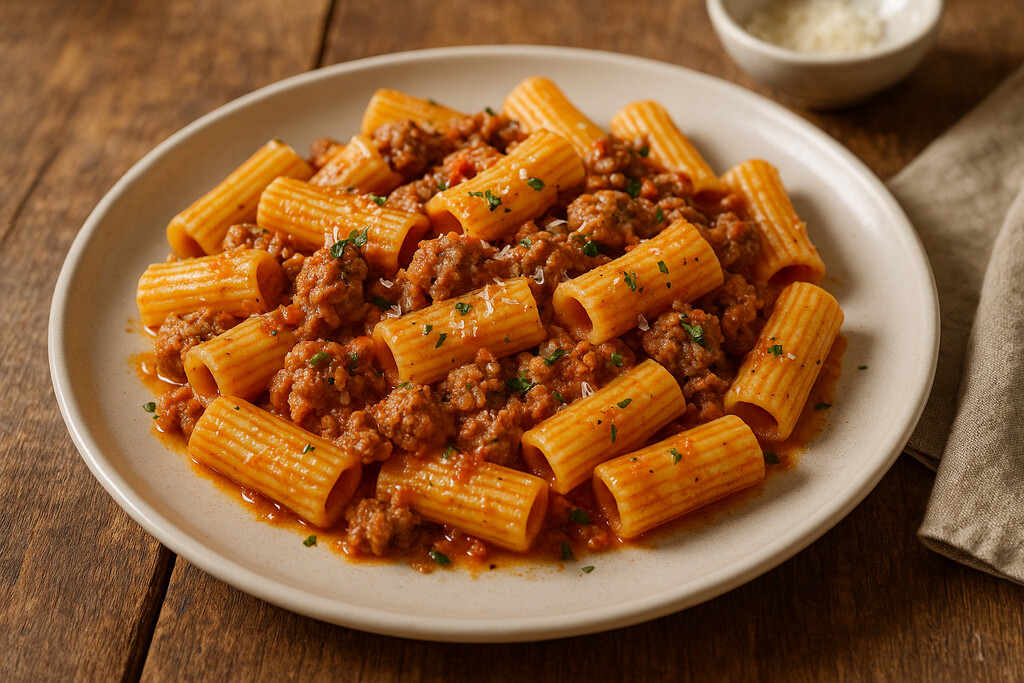
Rigatoni with fennel sausage sauce