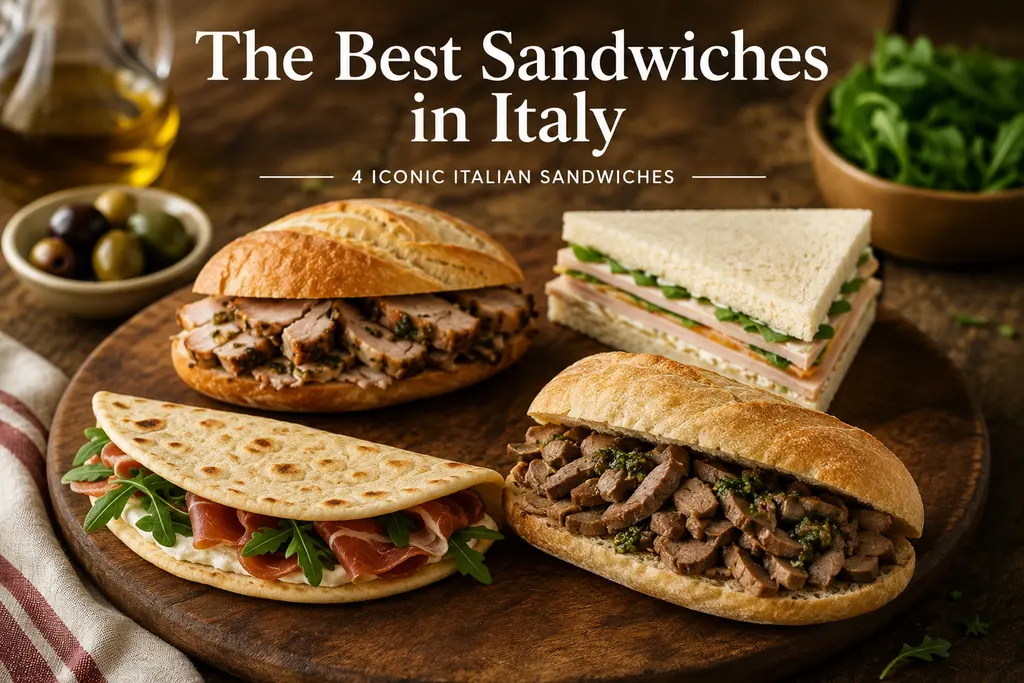
Best Sandwiches in Italy
Italy's sandwich culture is as regional as its pasta. From Florence's famous lampredotto to the soft tramezzini of Venice, each sandwich reflects local traditions, ingredients, and history.
The four sandwiches at a glance
To understand the Italian sandwich is to understand the geography of Italy itself. Unlike the globalised fast-food culture found elsewhere, Italy’s “panini” are deeply rooted in campanilismo—a fierce loyalty to one’s local bell tower. A sandwich in Venice bears almost no resemblance to one found in Florence or the hills of Lazio. These are not merely quick meals; they are portable expressions of regional history, agricultural necessity, and culinary pride.
While the word panino literally translates to “small bread,” the diversity of the category is immense. The Italian sandwich tradition ranges from the refined, crustless tea sandwiches of Northern cafes to the robust, offal-based street food of Tuscan markets. Each relies on a specific local bread—be it a lard-infused flatbread or a crusty, saltless roll—designed specifically to complement the textures and juices of its filling.
The following guide explores four of the most significant regional sandwiches in the Italian repertoire. Each represents a different facet of the country’s gastronomic identity, from the ancient tradition of whole-roast pork to the mid-century elegance of the Venetian bar scene.
| Sandwich | Region | Main ingredients | Bread | Served hot or cold? | Typical flavour |
|---|---|---|---|---|---|
| Panino con Porchetta | Lazio / Central Italy | Roasted deboned pork, herbs, crackling | Ciriole, Rosetta, or Pane di Genzano | Room temperature or warm | Savory, herbal, fatty, and salty |
| Tramezzino | Veneto / Piedmont | Mayonnaise, various fillings (tuna, egg, etc.) | Crustless white sliced bread | Cold | Creamy, delicate, and moist |
| Piadina Romagnola | Emilia-Romagna | Prosciutto, Squacquerone cheese, arugula | Unleavened flatbread | Hot | Rich, buttery, and tangy |
| Lampredotto Sandwich | Tuscany | Slow-cooked beef abomasum, salsa verde | Semelle (crusty roll) | Hot | Earthy, spicy, and succulent |
Panino con Porchetta
The Panino con Porchetta is perhaps Italy’s most celebrated contribution to the world of meat-based street food. At its core, it is a celebration of the hog. Unlike many sandwiches that rely on multiple condiments and toppings, a true porchetta sandwich relies almost entirely on the quality of the roast itself.
History and origin
The origins of porchetta are a point of friendly contention between several regions in Central Italy, specifically Lazio, Umbria, and Tuscany. However, the town of Ariccia, located in the Castelli Romani hills south of Rome, holds the most significant historical claim. Porchetta di Ariccia has been awarded the IGP (Protected Geographical Indication) status, signifying its cultural and technical importance. Historians suggest the practice of roasting whole pigs dates back to pre-Roman times, particularly associated with the sacrificial rites of the Latin League. By the 1950s, the “porchettari” (porchetta makers) of Ariccia had turned this ancient craft into a mobile street food phenomenon.
Traditional ingredients
A traditional porchetta is a whole pig that has been deboned, gutted, and seasoned with an abundance of sea salt, black pepper, and garlic. The defining herbal note depends on the geography: in Lazio, rosemary is the dominant aromatic, whereas in Umbria and parts of Tuscany, wild fennel (finocchietto) is preferred. The seasoned meat is rolled, tied with twine, and slow-roasted for several hours. This process creates a stark contrast between the succulent, tender interior and the cotenna (rind), which transforms into a hard, glass-like crackling.
How it is served and flavour profile
A Panino con Porchetta is rarely served piping hot. It is typically enjoyed at room temperature, which allows the fat to set slightly and the flavors of the herbs to permeate the meat more deeply. The vendor will carve thick slices of the roast, ensuring that every sandwich contains a mix of lean meat, melt-in-the-mouth fat, and at least one or two shards of crunchy crackling.
The flavour profile is an intense hit of umami, balanced by the woodsy fragrance of the herbs and the sharp bite of garlic. The bread used is traditionally a pane casareccio (home-style bread) or a rosetta—a hollow, rose-shaped roll that provides a light, airy vessel for the heavy meat.
Regional variations and uniqueness
While Ariccia is the gold standard, variations exist throughout the Apennine spine. In the Marche region, porchetta is often more heavily spiced with fennel. In Northern Italy, particularly in the Veneto, a similar preparation involves roasting just the pork belly (porchetta trevigiana). What makes the Panino con Porchetta unique is its purity; an authentic vendor will rarely offer mustard or mayonnaise. The moisture comes entirely from the pork’s own rendered fat and juices, creating a sandwich that is unapologetically rustic and focused.
Tramezzino
If the porchetta sandwich represents the rugged, rural heart of Italy, the Tramezzino represents its urban, sophisticated side. This is the quintessential Italian bar snack, designed to be eaten with one hand while holding a glass of Prosecco or a Negroni with the other.
History and origin
The Tramezzino was born in 1925 at Caffè Mulassano in Turin. The owners, Angela and Onorino Nebiolo, returned from the United States with a toaster and a vision for a new type of snack inspired by English tea sandwiches. However, it was the Italian poet and eccentric Gabriele D’Annunzio who gave the sandwich its name. He coined “tramezzino” as a diminutive of tramezzo (something in between), referring to a snack eaten between breakfast and lunch. While it started in Turin, the Tramezzino found its spiritual home in Venice, where it evolved into the bulging, crustless triangle we recognize today.
Traditional ingredients
The foundation of a Tramezzino is pane in cassetta—a high-quality, crustless white bread that is incredibly soft and slightly elastic. The second essential component is a thick layer of high-quality mayonnaise. This serves two purposes: it provides a creamy base and acts as a moisture barrier to keep the bread from drying out. Common fillings include tuna and hard-boiled eggs, artichokes and ham, shrimp with pink sauce, or even more modern combinations like radicchio and gorgonzola.
How it is served and flavour profile
Tramezzini are always served cold. In Venetian bars, they are often displayed under damp cloths to maintain their signature softness. The flavour profile is defined by its silkiness. There is no “crunch” here; instead, the experience is about the interplay of the soft bread and the cool, creamy fillings. The Venetian style is particularly famous for its “bulge”—the sandwich is packed so full in the center that it takes on a domed, almost spherical shape.
Regional variations and uniqueness
While you can find Tramezzini across Italy, the Venetian version is unparalleled. In Venice, the humidity of the lagoon is said to help keep the bread at the perfect level of suppleness. Unlike the English tea sandwich, which is flat and dainty, the Italian Tramezzino is generous and vibrant. It is unique because it defies the typical Italian preference for crusty, artisanal bread, proving that under the right circumstances, a soft, processed loaf can be a medium for high gastronomy.
Piadina Romagnola
The Piadina Romagnola is a flatbread sandwich that is emblematic of the Emilia-Romagna region, specifically the Adriatic coast. It is a food of ancient peasant origins that has transitioned into a staple of modern Italian street food.
History and origin
The piadina has a long and somewhat debated history. Some historians point to the Byzantine influence in Ravenna as the source of this unleavened bread, while others link it to the Etruscans. For centuries, it was known as the “bread of the poor,” a simple mixture of flour and water that could be cooked quickly on a terracotta plate (teglia) when yeast was unavailable or too expensive. It was the poet Giovanni Pascoli who eventually elevated its status, calling it “the bread of humanity” and cementing its place in the Italian cultural lexicon.
Traditional ingredients
The authentic Piadina Romagnola (which has IGP status) consists of four basic ingredients: wheat flour, water, salt, and fat. Traditionally, that fat is strutto (pork lard), which gives the piadina its characteristic silkiness and flaky texture. While olive oil is sometimes used in modern, health-conscious versions, it lacks the depth of flavour and structural integrity provided by the lard. There are two main styles: the Romagnola style (thicker and smaller) and the Rimini style (wider and thinner).
How it is served and flavour profile
The piadina is always served hot, freshly cooked on a griddle. Once cooked, it is folded in half and filled. The classic filling—and arguably the best—is a combination of Prosciutto di Parma, Squacquerone (a very soft, tangy, and spreadable fresh cheese), and fresh arugula (rucola). The heat of the bread slightly melts the cheese and warms the ham, while the arugula provides a peppery, fresh contrast. The flavour is rich and buttery, with the charred spots on the flatbread adding a hint of smokiness.
Regional variations and uniqueness
Within the Emilia-Romagna region, the thickness of the piadina is a matter of intense local debate. In Forlì and Cesena, it is roughly a centimeter thick, offering a chewy, bread-like experience. As you move toward the coast at Rimini, it becomes thinner and more flexible, almost like a heavy tortilla. What makes the piadina unique is its versatility; it can be a light snack or a heavy meal, and it represents a rare example of a traditional Italian unleavened bread that has survived into the modern era.
Lampredotto Sandwich
To eat a Lampredotto sandwich is to partake in a ritual that is exclusively and fiercely Florentine. It is perhaps the most “extreme” of the Italian regional sandwiches, but for those who value depth of flavour over aesthetics, it is the ultimate street food.
History and origin
Lampredotto is a classic example of cibo povero (poor man’s food). It originated in the 15th century among the workers of Florence’s public slaughterhouses. These workers were often paid in “fifth quarter” cuts—the offal and scraps that the wealthy wouldn’t eat. The name “lampredotto” comes from the lamprey eel (lampreda), which was once common in the Arno river; the cooked stomach of the cow was thought to resemble the pleated mouth of the eel.
Traditional ingredients
Lampredotto is made from the fourth stomach of the cow, known as the abomasum. Unlike the honeycomb tripe found in most trippa dishes, lampredotto is composed of two parts: the gala, which is lean and ruffled, and the spannocchia, which is fattier and more intensely flavoured. The meat is slow-cooked in a broth of tomato, onion, celery, and parsley until it is incredibly tender.
How it is served and flavour profile
The sandwich is served in a semelle—a round, crusty Tuscan roll with a soft interior. The trippaio (tripe seller) removes the meat from the steaming broth, chops it finely on a wooden board, and seasons it with salt and pepper. The customer is then asked two crucial questions: “Salsa verde?” (a piquant green sauce made of parsley, capers, and anchovies) and “Piccante?” (spicy oil). Finally, the top of the bun is briefly dipped into the cooking broth (bagnato), ensuring the bread is moist and infused with the essence of the meat.
Regional variations and uniqueness
There are no regional variations of lampredotto because it exists nowhere else but Florence. You cannot find it in Rome, Milan, or even elsewhere in Tuscany. It is a hyper-local delicacy. What makes it unique is the specific texture—silky, slightly gelatinous, and tender—and the ritual of the trippaio stands, which remain social hubs for everyone from construction workers to businessmen in the city center.
How these Italian sandwiches compare
While all four sandwiches are beloved staples, they occupy different niches in the Italian lifestyle. The primary similarity lies in the quality of the bread; in every case, the bread is not merely a container but a functional component designed to interact with the filling.
Bread styles and fillings
The bread styles reflect the regional agriculture. The Piadina uses wheat and lard from the fertile plains of Emilia-Romagna. The Lampredotto uses the saltless Tuscan bread (pane sciocco), which was historically a response to salt taxes and serves as the perfect neutral vessel for salty, savory meats. The Tramezzino uses soft, refined flour, reflecting its origin in the sophisticated cafes of the North.
The fillings also highlight regional specialities:
- Central Italy (Porchetta): Focuses on preservation through roasting and heavy spicing.
- Northern Italy (Tramezzino): Emphasizes creamy textures and delicate seafood or vegetable combinations.
- Emilia-Romagna (Piadina): Showcases world-class cured meats and fresh dairy.
- Tuscany (Lampredotto): Demonstrates the art of transforming humble offal into a delicacy through slow-cooking.
Comparison Table: Textures and Occasions
| Sandwich | Texture | Primary Fat Source | Typical Setting |
|---|---|---|---|
| Porchetta | Crunchy & Succulent | Pork fat/lard | Roadside trucks, festivals |
| Tramezzino | Soft & Silky | Mayonnaise | Mid-day bar snack |
| Piadina | Flaky & Chewy | Lard (in the dough) | Casual kiosks (baracchini) |
| Lampredotto | Tender & Brothy | Meat broth / Fat | Standing at a market stall |
How Italians eat them
The way these sandwiches are consumed also differs. A Tramezzino is an aperitivo or a light lunch, usually eaten standing up at a bar. A Lampredotto or a Porchetta sandwich is a “destination” meal—people will travel to a specific truck or stall for their favorite version. The Piadina is a social food, often eaten in dedicated piadinerie along the coast during the summer months.
Which Italian sandwich should you try first?
Choosing where to start depends entirely on your palate and your comfort level with traditional ingredients.
For the first-time visitor to Italy: Start with the Panino con Porchetta. It is universally accessible, incredibly savory, and perfectly captures the rustic appeal of Italian food. It is the safest bet for anyone who loves roast pork.
For the meat lover: The Piadina Romagnola filled with Prosciutto di Parma is the ultimate choice. The combination of high-quality cured meat and the rich, lard-based flatbread is a masterclass in fat and salt.
For the adventurous eater: The Lampredotto Sandwich is essential. While the idea of eating cow stomach can be daunting, the flavour is surprisingly mild and earthy, more akin to a very tender roast beef than traditional tripe. It is the badge of honor for any true food enthusiast in Italy.
For someone looking for a light lunch: Choose the Tramezzino. It is the least heavy of the four and offers a wide variety of fillings, making it easy to have a quick, refined bite without the “food coma” that might follow a heavy pork sandwich.
For the street food enthusiast: Both the Porchetta and the Lampredotto are iconic, but the Lampredotto stands out for its unique serving style and the theater of the trippaio. It is arguably the most authentic street food experience in the country.
Conclusion
Italian sandwiches are a reminder that “fast food” can still be “slow food.” Whether it is a pig that was roasted for eight hours or a stomach simmered until tender, these sandwiches are built on time and tradition. Exploring them offers a deeper understanding of Italy’s regional diversity, proving that sometimes the best way to experience a culture is between two slices of bread.
You may also enjoy
Pizza Express Margherita
 37 min

Spaghetti alla Carbonara
Osso Buco alla Milanese
Ribollita
Venetian Duck Ragu
Pilchard puttanesca
Lasagne
Spicy Arrabiata Penne